
What does power awareness mean when working at heights, what are the biggest risks, and how can proper training help workers stay safe?
Working at heights is a normal part of many industries, but it should never be treated as routine or risk-free.
Construction workers, telecommunications technicians, tower workers, maintenance teams and other professionals may regularly perform tasks above ground level. Depending on the job, they may work from ladders, elevated platforms, rooftops, poles, structures or telecommunications towers.
These environments can introduce multiple hazards at the same time.
Falls are an obvious concern, but workers may also encounter electrical hazards, unstable surfaces, falling objects, equipment failure, changing weather conditions and restricted work areas.
This is where power awareness and working safely at heights become particularly important.
Power awareness is about understanding the hazards around you, recognising potential sources of danger and making informed decisions before and during work.
It is not simply about electricity.
It is about being aware of the entire work environment, the risks involved and the controls required to perform the task safely.
What Is Power Awareness When Working at Heights?
Power awareness means having a clear understanding of potential hazards, including electrical risks, equipment, surroundings, environmental conditions and safe work procedures.
When working at heights, workers may be exposed to several hazards simultaneously.
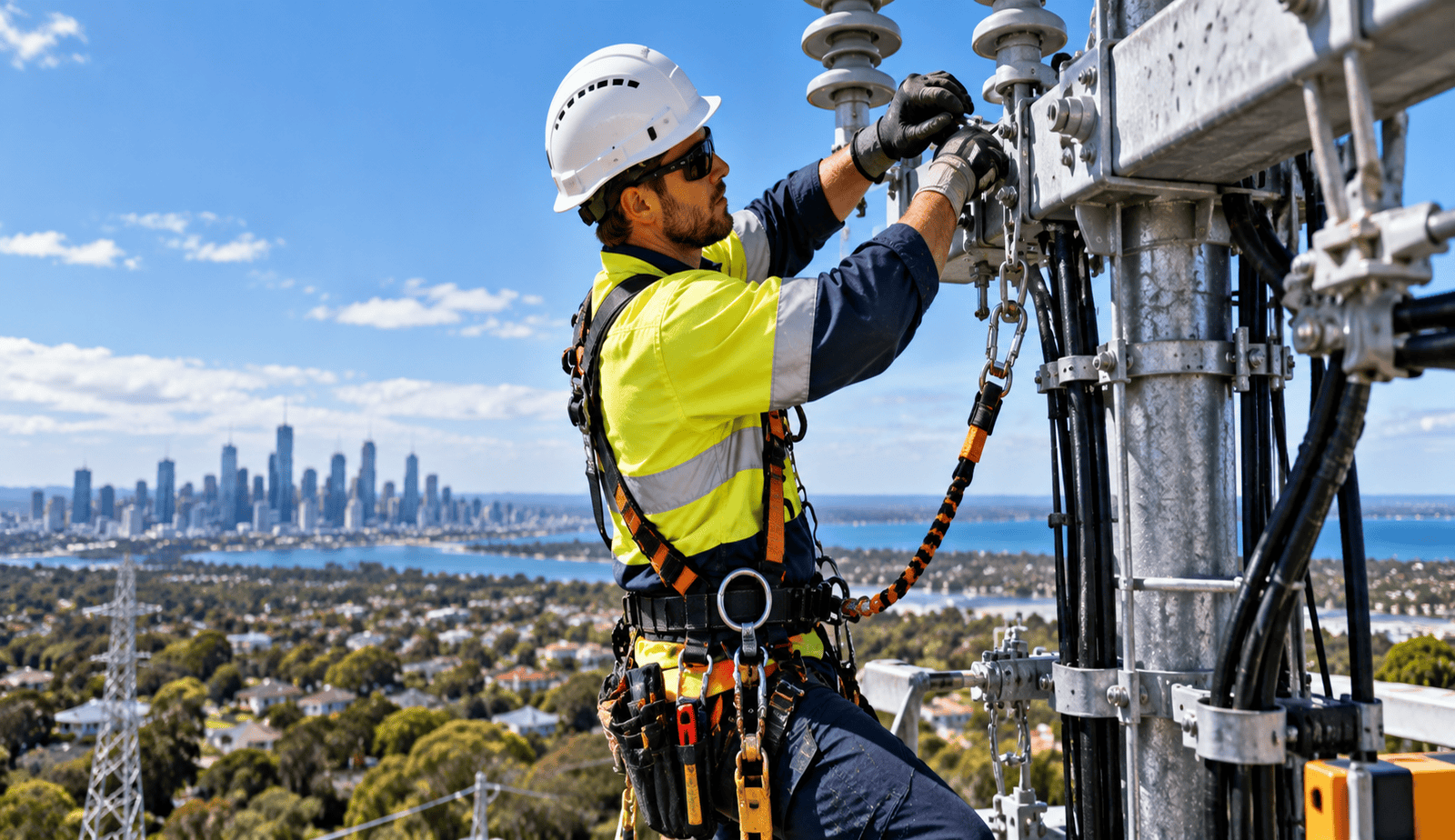
For example, a telecommunications technician working on a tower may need to consider:
- Height and fall risks
- Electrical infrastructure
- Weather conditions
- Communication equipment
- Tools and equipment
- Structural stability
- Falling objects
- Access and egress
- Emergency arrangements
Being aware of these hazards allows workers to assess the situation before beginning the task.
The goal is simple:
Identify the hazard. Assess the risk. Control the risk. Work safely.
Why Is Working Safely at Heights So Important?
Working above ground introduces consequences that can be significantly more serious when something goes wrong.
A slip, loss of balance, equipment failure or incorrect movement can result in a fall.
However, height-related risks are not limited to falling.
Workers may also face:
- Electrical contact
- Falling tools or materials
- Unstable platforms
- Damaged ladders
- Incorrectly used fall protection
- Poorly secured equipment
- Strong winds
- Rain and slippery surfaces
- Heat or cold exposure
- Fatigue
- Poor visibility
This is why working at heights should always involve appropriate planning, risk assessment, equipment and training.
The Biggest Risks When Working at Heights
Understanding common hazards is the first step towards controlling them.
- Falls From Height
Falls are one of the most obvious risks associated with elevated work.
A worker can fall because of:
- Loss of balance
- Slippery surfaces
- Incorrect equipment use
- Unprotected edges
- Damaged access equipment
- Poor work positioning
- Unexpected movement
- Inadequate fall protection
Workers need to understand the specific risks associated with their work environment and use appropriate control measures.
- Electrical Hazards
Power awareness becomes especially important when electrical infrastructure is present.
Telecommunications workers, construction workers and maintenance personnel may work near electrical equipment or infrastructure.
Potential electrical hazards can include:
- Overhead powerlines
- Energised equipment
- Electrical installations
- Damaged cables
- Unexpected sources of energy
Workers should never assume that an electrical hazard is safe simply because it is not immediately visible.
Identifying energy sources and following the appropriate safety procedures is essential.
- Falling Objects
Working at height can create risks for people below.
Tools, equipment and materials can fall if they are not properly secured.
A small object dropped from an elevated position can cause serious injury.
For this reason, height work requires consideration of both:
The worker at height and everyone working or moving below.
- Weather Conditions
Weather can dramatically change the safety of elevated work.
Wind can affect balance and equipment.
Rain can make surfaces slippery.
Extreme temperatures can contribute to fatigue or reduced concentration.
Before starting height-related work, workers should consider current and forecast weather conditions and follow workplace procedures for determining whether the task can be performed safely.
If conditions become unsafe, stopping or postponing the task may be the safest decision.
5 Essential Principles for Working Safely at Heights
- Know Your Work Environment
Before beginning work, understand the location and identify potential hazards.
Ask:
- What is above me?
- What is below me?
- What is around me?
- Are there electrical hazards?
- Is the surface stable?
- What equipment will I use?
- What could change during the task?
- What is the emergency plan?
This creates a broader safety perspective.
- Use the Right Safety Equipment
Safety equipment can play an important role in controlling height-related risks.
Depending on the task and workplace requirements, equipment may include:
- Harnesses
- Lanyards
- Anchors
- Helmets
- Protective footwear
- Gloves
- Eye protection
- Fall protection systems
- Appropriate access equipment
However, simply wearing equipment does not automatically make a task safe.
Workers need to understand the correct selection, inspection, use and limitations of equipment.
- Inspect Equipment Before Use
Damaged equipment can introduce additional hazards.
Before using safety or access equipment, workers should follow workplace procedures for inspection.
Look for signs such as:
- Damage
- Wear
- Cuts
- Fraying
- Corrosion
- Missing components
- Deformation
- Faults
If equipment does not meet the required condition, it should not be used until the appropriate action has been taken.
- Maintain Situational Awareness
Working safely at heights requires more than focusing on the task directly in front of you.
A 360-degree safety mindset means considering everything around you.
A loose component, changing wind direction, damaged cable, unstable surface or person entering the work area can change the risk profile.
Good situational awareness means continuously asking:
“Has anything changed?”
If the answer is yes, stop and reassess before continuing.
- Know the Emergency Plan
Every height-related task should consider what happens if something goes wrong.
Workers should understand the relevant workplace emergency procedures and know how to raise an alarm or obtain assistance.
Emergency planning is particularly important for remote, elevated or difficult-to-access locations.
A rescue plan should be appropriate to the work being undertaken and should not rely solely on emergency services arriving after an incident.
Power Awareness: More Than Just Electrical Safety
The term power awareness can sometimes be misunderstood as simply “electrical awareness”.
Electrical hazards are certainly important, but effective power awareness is broader.
It involves understanding the different forces, hazards and conditions that can affect the safety of a task.
For example:
Electrical Energy
Understand potential electrical sources and maintain required controls.
Gravity
Recognise the consequences of falls, dropped objects and unstable equipment.
Weather
Consider wind, rain, heat and other environmental conditions.
Equipment
Understand the correct use, inspection and limitations of tools and safety equipment.
Human Factors
Fatigue, distraction, poor communication and rushing can all influence workplace safety.
True power awareness means understanding what can go wrong before it goes wrong.
Why Training Matters When Working at Heights
Experience is valuable, but experience alone should not replace appropriate training.
A worker may perform the same task many times without an incident and still encounter an unexpected hazard on the next job.
Training can help workers understand:
- Hazard identification
- Risk assessment
- Control measures
- Safe work procedures
- Fall prevention
- Personal protective equipment
- Equipment inspection
- Emergency procedures
- Workplace responsibilities
It also provides an opportunity to practise applying safety knowledge before encountering a real-world situation.
Theory + Practical Training: Why Both Matter
Safety knowledge becomes more useful when workers understand how to apply it.
Practical training can help participants become familiar with relevant equipment, procedures and workplace scenarios.
Depending on the training program, practical activities may include simulated work situations where participants learn to recognise hazards and apply appropriate controls.
This combination of knowledge and practical application can help build confidence and reinforce safe work habits.
Working Safely at Heights in Telecommunications
Telecommunications is one industry where height safety can be particularly important.
Technicians may work around:
- Telecommunications towers
- Poles
- Rooftops
- Antennas
- Communication structures
- Elevated equipment
- Cabling infrastructure
A telecommunications worksite can also involve electrical infrastructure and changing environmental conditions.
This means technicians need to think beyond the immediate task.
Before climbing or accessing an elevated location, workers should consider the work area, equipment, weather, access arrangements, potential energy sources and applicable workplace procedures.
Height safety should be part of the job plan—not an afterthought.
How Can Workers Improve Their Safety Awareness?
Developing strong safety awareness is an ongoing process.
Workers can strengthen their approach by:
Stop Before You Start
Take time to understand the job before beginning.
Identify Hazards
Look for potential risks around the entire work area.
Assess the Risk
Consider what could happen and how serious the consequences could be.
Apply Controls
Use appropriate controls according to workplace procedures and the relevant hierarchy of controls.
Check Equipment
Make sure equipment is suitable and in the required condition.
Monitor Conditions
Continue watching for changes throughout the task.
Speak Up
If something appears unsafe, raise the concern rather than ignoring it.
Stop When Conditions Change
A task that was safe earlier may become unsafe because of weather, equipment, environmental or other changes.
The Role of Employers in Height Safety
Safety is not solely the responsibility of individual workers.
Employers also have an important role in establishing safe systems of work.
This can include providing:
- Appropriate training
- Suitable equipment
- Workplace procedures
- Risk management processes
- Supervision where required
- Emergency arrangements
- Equipment inspection processes
- Safety information
A strong workplace safety culture encourages employees to report hazards and stop when work cannot be performed safely.
The Role of Workers in Creating a Safety Culture
Workers also have responsibilities.
A strong safety culture depends on people following procedures, using equipment correctly and communicating when they identify hazards.
Workers should avoid:
- Taking unnecessary shortcuts
- Ignoring damaged equipment
- Working outside their training
- Continuing when conditions become unsafe
- Assuming another person has checked the hazard
- Treating familiar tasks as automatically safe
Familiarity should never replace awareness.
Why Weather Awareness Matters at Heights
Weather can change quickly, particularly at exposed locations.
Wind is especially important for elevated work because it can affect balance, equipment and materials.
Rain can create slippery surfaces, while extreme temperatures can contribute to fatigue and reduced concentration.
Workers and employers should follow applicable workplace procedures and assess whether environmental conditions remain suitable for the planned task.
Sometimes the safest decision is simply:
Wait. Reassess. Work when conditions are safe.
Is Working at Heights Training Important for Telecommunications Workers?
Yes. Appropriate working-at-heights training can be important for workers whose duties involve elevated work.
Telecommunications technicians may encounter towers, poles, rooftops and other elevated work environments.
However, training requirements depend on the specific work, workplace and applicable Australian safety requirements.
Workers should complete the training required for their role and follow their employer’s safe work procedures.
Power Awareness and Working Safely at Heights: A Simple Safety Checklist
Before starting elevated work, consider:
PLAN
What exactly am I doing?
IDENTIFY
What hazards are present?
ASSESS
What could go wrong?
CONTROL
What controls are required?
CHECK
Is my equipment suitable and in good condition?
MONITOR
Have conditions changed?
COMMUNICATE
Does everyone understand the work and emergency arrangements?
STOP
If the conditions are unsafe, stop and reassess.
This simple mindset can help workers approach elevated tasks more deliberately.
Frequently Asked Questions About Power Awareness and Working at Heights
What does power awareness mean in workplace safety?
Power awareness means understanding potential sources of danger and the conditions surrounding a task. While it includes awareness of electrical hazards, it can also involve recognising risks associated with equipment, gravity, weather, the work environment and human factors.
Why is power awareness important when working at heights?
Power awareness helps workers identify hazards before and during elevated work. It encourages workers to assess their surroundings, understand potential energy sources, use appropriate controls and respond when conditions change.
What are the main risks of working at heights?
Common risks can include falls, falling objects, electrical hazards, unstable surfaces, equipment failure, adverse weather and human factors such as fatigue or distraction.
How can workers stay safe when working at heights?
Workers should follow appropriate workplace procedures, identify hazards, use suitable fall protection and other safety equipment, inspect equipment, monitor environmental conditions and understand emergency arrangements.
Is a safety harness enough to prevent falls?
No. A harness is only one part of an appropriate fall protection system. Workers need to understand the correct equipment, attachment arrangements, inspection requirements and procedures applicable to their task.
Why is weather important when working at heights?
Wind, rain, extreme temperatures and other weather conditions can affect balance, surfaces, equipment and concentration. Weather conditions should therefore be considered as part of the work risk assessment and workplace procedures.
Is working at heights training required in Australia?
Training requirements depend on the work being performed and the applicable workplace health and safety requirements. Workers should determine the training required for their specific role and work environment.
Why is training better than relying only on experience?
Experience can help workers understand their jobs, but training provides structured knowledge about hazards, controls, equipment and safe procedures. A combination of appropriate training and practical experience can support safer work practices.
Does power awareness only apply to electricians?
No. Power awareness can be relevant to many workers who may encounter electrical or other energy-related hazards. It is particularly important for workers operating around electrical infrastructure, telecommunications equipment, construction environments and elevated work areas.
Conclusion: Safety Starts With Awareness
Working at heights requires more than confidence.
It requires planning, knowledge, appropriate equipment, hazard awareness and the discipline to stop when conditions are unsafe.
For telecommunications technicians, construction workers and other professionals working in elevated environments, power awareness can help create a stronger understanding of the hazards surrounding each task.
The safest approach is not to assume that experience alone will protect you.
Instead:
Identify the hazard.
Assess the risk.
Control the risk.
Use the right equipment.
Stay aware.
Work safely.
When safety becomes part of every decision, workers are better prepared to manage the challenges of working at heights.
Because when you’re working above the ground, awareness isn’t optional — it’s part of the job.