
What is Gas Test Atmospheres Training, why is it important, and who needs it?
In workplaces where hazardous gases, vapours, fumes or oxygen-deficient atmospheres may occur, recognising the danger before work begins is essential. Some atmospheric hazards cannot be seen or smelled, which means workers need the right knowledge, equipment and procedures to identify potential risks.
This is where Gas Test Atmospheres Training plays an important role.
Gas testing training helps workers understand atmospheric hazards, use appropriate gas detection equipment and interpret readings so they can contribute to safer work practices. It can be particularly relevant to industries such as construction, telecommunications, utilities, infrastructure, manufacturing, mining and underground services.
For workers searching for “Gas Test Atmospheres Training near me”, understanding what the training involves and how it supports workplace safety is a useful first step.
What Is Gas Test Atmospheres Training?
Gas Test Atmospheres Training is designed to develop the knowledge and practical skills needed to identify and assess potentially hazardous workplace atmospheres.
Depending on the course and workplace requirements, training may cover:
- Types of hazardous gases and vapours
- Oxygen deficiency and enrichment
- Atmospheric hazards
- Gas detection equipment
- Sampling and testing procedures
- Gas detector readings and alarms
- Equipment limitations
- Workplace safety procedures
- Responding to potentially hazardous conditions
The purpose is not simply to teach workers how to operate a gas detector. It is about helping them understand why atmospheric testing is required, how to conduct testing appropriately and what actions may be necessary when hazardous conditions are identified.
Why Is Gas Testing Important in the Workplace?
A workplace can look completely safe while the atmosphere presents a serious hazard.
Certain gases and vapours may be colourless or odourless. Atmospheric conditions can also change because of ventilation, temperature, work activities, chemicals, combustion or other environmental factors.
Gas testing can provide workers with information about the atmosphere that cannot be obtained through visual observation alone.
Proper gas testing can help workers:
- Identify potential atmospheric hazards.
- Detect changes in atmospheric conditions.
- Support workplace risk assessments.
- Determine whether additional controls may be required.
- Recognise alarm conditions.
- Follow appropriate emergency procedures.
- Make safer decisions within their responsibilities.
However, gas testing should always be considered as one part of a broader risk-management process rather than a replacement for other safety controls.
What Are the Main Atmospheric Hazards?
Understanding different atmospheric hazards is an important part of gas testing awareness.
Oxygen Deficiency
An atmosphere with insufficient oxygen can create a serious risk to workers. Oxygen levels may be affected by displacement from other gases, chemical processes, combustion or poor ventilation.
Oxygen Enrichment
Excess oxygen can also increase fire and combustion risks. Workers therefore need to understand that both low and unusually high oxygen concentrations can be hazardous.
Toxic Gases
Some gases can be harmful when inhaled, even at relatively low concentrations. Workers need appropriate training to understand the potential hazards associated with the environments in which they work.
Flammable Gases and Vapours
Certain gases and vapours can create a fire or explosion risk when present at concentrations within their flammable range and when an ignition source is available.
Fumes and Contaminants
Industrial processes, chemicals, decomposition and other activities can introduce harmful contaminants into the atmosphere.
These hazards demonstrate why workers should not rely solely on their senses when assessing an environment.
How Does Gas Detection Equipment Work?
Gas detectors are designed to identify specific atmospheric hazards using sensors configured for particular gases or conditions.
Depending on the equipment, a detector may provide information relating to:
- Oxygen concentration
- Flammable gases
- Specific toxic gases
- Alarm conditions
- Other measurable atmospheric parameters
Workers undertaking gas testing need to understand the equipment they are using, including its operating instructions, limitations, alarm functions and required checks.
Training can help participants become more familiar with gas detectors and other equipment used for atmospheric testing.
Why Is Practical Training Important?
Gas testing is a practical workplace competency.
Understanding the theory is important, but workers also need to know how to apply that knowledge when using actual equipment.
Practical training can help participants become familiar with:
- Gas detectors
- Sampling equipment
- Probes
- Sensors
- Testing procedures
- Equipment checks
- Display readings
- Alarm responses
Hands-on learning can help workers develop greater confidence with equipment before applying their skills in the workplace.
The exact practical requirements will depend on the training program and the competency being delivered.
How Should Workers Interpret Gas Detector Readings?
Knowing how to read a gas detector is only part of the process.
Workers must understand what readings mean within the context of the work environment and the equipment being used.
Training can help workers recognise:
- Normal and abnormal readings
- Alarm conditions
- Changing atmospheric conditions
- Potentially hazardous readings
- Equipment limitations
- Situations requiring work to stop
- When an issue should be reported or escalated
Workers should always follow their workplace procedures and the manufacturer’s instructions for the equipment.
Gas Testing and Confined Spaces
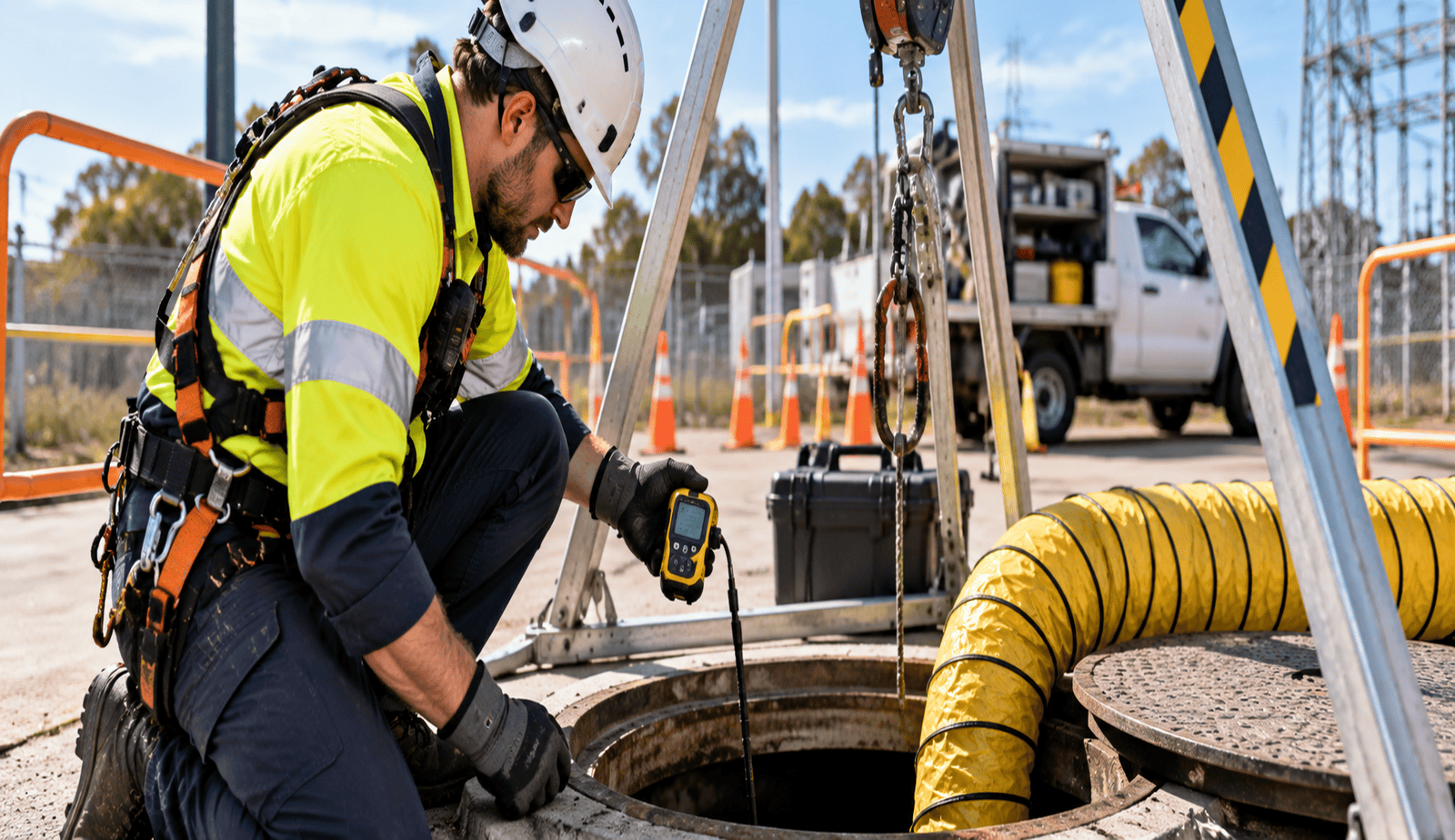
Confined spaces can present complex atmospheric hazards, particularly where ventilation is restricted or hazardous substances can accumulate.
Where atmospheric hazards are reasonably foreseeable, gas testing may form part of the overall risk-control process.
Potential concerns can include:
- Oxygen deficiency
- Toxic gases
- Flammable atmospheres
- Hazardous vapours
- Contaminants entering the space
- Changes in atmospheric conditions
It is important to remember that gas testing alone does not make a confined space safe.
Depending on the circumstances, confined-space work may also require appropriate risk assessment, isolation, ventilation, communication, emergency arrangements, personal protective equipment and other controls.
Can Atmospheric Conditions Change During Work?
Yes. Atmospheric conditions are not necessarily static.
Changes may occur because of:
- Work activities
- Ventilation changes
- Chemical processes
- Temperature
- Environmental conditions
- Movement of gases or vapours
- Changes to surrounding infrastructure
For this reason, workers should follow workplace procedures regarding when and how atmospheric conditions need to be tested or monitored.
A single test should not automatically be assumed to represent conditions for the entire duration of a task.
What Happens When a Gas Detector Alarms?
A gas detector alarm should always be treated seriously.
The correct response depends on the type of detector, the alarm condition, workplace procedures and the hazards present.
Workers should be trained to understand how to:
- Recognise the alarm.
- Stop or suspend work when required.
- Follow the site’s emergency procedures.
- Move to a safe location when instructed.
- Notify the appropriate responsible person.
- Avoid entering or re-entering an unsafe area unless authorised and appropriate controls have been established.
Workers should never ignore an alarm simply because the environment appears normal.
Who Should Complete Gas Test Atmospheres Training?
Gas testing training may be relevant to workers who operate in environments where hazardous atmospheres could occur.
Depending on workplace requirements, this may include people working in:
- Telecommunications
- Construction
- Utilities
- Infrastructure
- Mining
- Manufacturing
- Civil works
- Underground services
- Industrial maintenance
- Other high-risk environments
The exact training required depends on the worker’s responsibilities, workplace hazards, applicable requirements and employer procedures.
Gas Testing for Telecommunications and Underground Workers
Gas awareness can be particularly relevant for workers involved in telecommunications and underground infrastructure.
Telecommunications workers may work around pits, underground services and infrastructure where environmental conditions can vary.
Having appropriate knowledge of atmospheric hazards can complement other workplace safety competencies.
Workers may need to understand how to:
- Identify potential atmospheric risks.
- Assess the work environment.
- Use suitable detection equipment.
- Follow site procedures.
- Recognise changing conditions.
- Communicate hazards.
- Respond appropriately to unsafe readings.
This knowledge can contribute to a stronger safety culture across telecommunications and infrastructure projects.
Is Gas Test Atmospheres Training Mandatory?
There is no single answer that applies to every worker and every workplace.
Whether specific gas testing training is required can depend on the worker’s duties, workplace hazards, applicable legislation, project requirements and employer procedures.
Organisations should identify competency requirements through their risk-management processes and ensure workers receive training appropriate to the tasks they perform.
Before enrolling in a course, workers should confirm which competencies are required for their particular role or workplace.
How to Find Gas Test Atmospheres Training Near Me
Searching for “Gas Test Atmospheres Training near me” can help you identify nearby training providers, but location should not be the only consideration.
Before choosing a course, consider:
Course Content
Check whether the course covers the atmospheric hazards and gas testing skills relevant to your work.
Practical Components
If practical competency is required, find out whether the training includes appropriate hands-on activities.
Industry Relevance
Look for training that is suitable for your industry and workplace environment.
Training Delivery
Check whether the course is delivered face-to-face, through blended learning or another suitable format.
Recognition and Requirements
Confirm that the course or competency meets the requirements relevant to your employer, project or role.
Trainer and Training Provider
Consider the provider’s experience, facilities, training approach and reputation before enrolling.
What Are the Benefits of Gas Test Atmospheres Training?
Appropriate training can provide several benefits for workers and employers.
Better Hazard Awareness
Workers can become more aware of atmospheric hazards that may not be immediately visible.
Improved Equipment Confidence
Practical experience can help workers become more comfortable using gas detection equipment correctly.
Safer Decision-Making
Understanding readings and alarm conditions can support better decisions within established workplace procedures.
Stronger Safety Culture
Competent workers can contribute to a workplace where hazards are identified and managed proactively.
Improved Workplace Readiness
Training can help workers prepare for situations where atmospheric conditions change unexpectedly.
Gas Testing Is Part of a Bigger Safety Strategy
Gas testing should not be viewed as a standalone safety measure.
A broader approach may involve:
Identify → Assess → Control → Test → Monitor → Communicate → Respond
The exact controls will depend on the workplace and task.
Workers should also understand that gas detectors have limitations. Equipment must be suitable for the hazards being assessed and used, maintained and checked according to applicable instructions and workplace procedures.
Why Is Gas Test Atmospheres Training a Valuable Workplace Skill?
Workplace safety depends heavily on workers being able to recognise hazards before they become incidents.
Gas testing knowledge can help workers understand potentially dangerous atmospheric conditions and use appropriate equipment and procedures to assess those risks.
For employers, having appropriately trained workers can contribute to better safety practices and workplace readiness.
For workers, relevant training can strengthen their technical skill set and support their ability to work safely in environments where atmospheric hazards may be present.
Frequently Asked Questions
What is Gas Test Atmospheres Training?
Gas Test Atmospheres Training develops knowledge and practical skills for identifying potentially hazardous atmospheres and using appropriate gas detection equipment.
Why is gas testing important?
Gas testing can identify atmospheric hazards that may not be visible or detectable through smell. It can provide information that supports workplace risk controls and safety procedures.
Is gas testing required in confined spaces?
Gas testing may be required or recommended where hazardous atmospheric conditions could exist. The specific requirements depend on the work, workplace and applicable safety requirements.
Can a gas detector detect every hazardous substance?
No. Detection equipment is designed for particular gases or atmospheric conditions. Workers need to understand the detector’s capabilities and limitations.
Who needs gas testing training?
Workers whose duties involve environments where hazardous atmospheres may occur may require appropriate gas testing competency. Requirements depend on the specific role and workplace.
How can I find Gas Test Atmospheres Training near me?
Search for reputable training providers in your area and compare course content, practical training, delivery options and workplace relevance before enrolling.
Is online training enough for gas testing?
The suitability of online learning depends on the specific course and competency requirements. Gas testing can involve practical equipment and assessment, so workers should confirm whether hands-on training is required.
Final Thoughts
Gas Test Atmospheres Training is about more than learning how to operate a gas detector.
It is about developing awareness of atmospheric hazards, understanding testing procedures, interpreting equipment readings and knowing how to respond appropriately when conditions become unsafe.
For workers in telecommunications, construction, utilities, infrastructure and other industries where hazardous atmospheres may occur, appropriate training can be an important part of workplace safety.
If you are searching for Gas Test Atmospheres Training near you, look beyond location and choose training that aligns with your job responsibilities, workplace hazards and competency requirements.
At MILCOM Institute, workers can explore relevant training designed to support safer work practices across telecommunications and technical environments.
Because when it comes to hazardous atmospheres, awareness, preparation and the right skills can make all the difference.