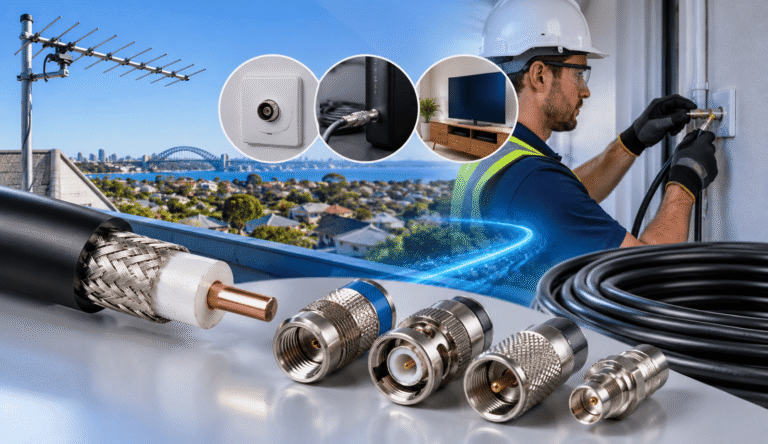

Are There Different Types of Coaxial Cables?
Coaxial cables have been used to transmit radio and video signals since the early 20th century. Espenschied and Affel filed the original patent for coaxial cable in 1929, and it was granted in 1931. Since then, “coax” has been used to carry data for a huge range of applications.
Quick answer: what are the main types of coaxial cable?
Yes — there are several types of coaxial cable, each suited to different applications:
- RG-6 — standard residential cable TV
- RG-59 — lightweight, low-frequency, short-range (basic CCTV, analogue TV)
- RG-11 — higher-gauge, used for HDTV signals
- Hybrid Fibre-Coaxial (HFC) — fibre to the node, coax to the home; used for pay TV and the NBN
- Hard-Line coaxial — thick, heavy-duty cable historically used in commercial buildings
- Semi-Rigid coaxial — solid copper casing, superior shielding, low flexibility
- Triaxial cable — extra shielding layer for higher bandwidth and less interference
- Twinaxial cable — two inner conductors, used in high-speed local area networks
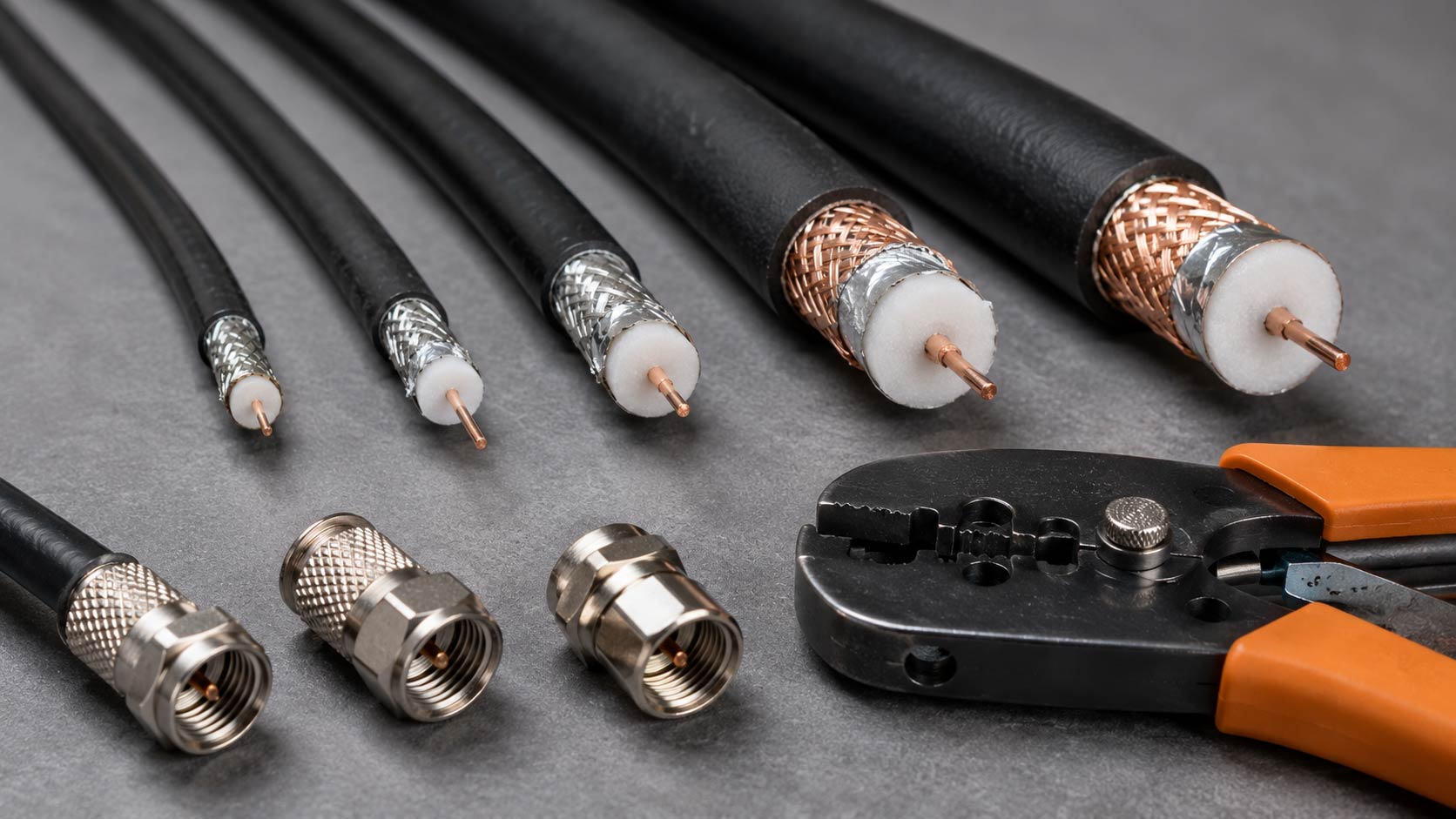
They all share the same basic design — a central conductor, insulation, and a shielded outer sheath running along a single axis — but differ in gauge, flexibility, shielding and the frequency range they’re built to handle.
Coaxial cable is highly efficient at transporting high-frequency signals, which makes it ideal for broadband applications. It’s also well suited to linking satellites and devices, making it a reliable choice for television signals. Its shielded design adds durability too — the outer sheath protects the conductors inside, which share a single axis, hence the name “coaxial.”
RG-6 Coaxial Cable
RG-6 is the generic term for the coaxial cabling found in most residential properties. It has an impedance of 75 ohms and is made with insulated, copper-clad steel or solid copper centre conductors. It’s typically used for cable television.
RG-59 Coaxial Cable
RG-59 is the lightweight version of RG-6, with a thinner conductor and less insulation and shielding. That makes it a low-cost, easy-to-install option for short-range, low-frequency applications like analogue television signals or basic (non-HD) CCTV setups.
RG-11 Coaxial Cable
RG-11 is the evolution of RG-6 and offers far superior performance thanks to a much higher-gauge wire. It’s the preferred option for HDTV signals, although its extra thickness makes it less flexible and more difficult to install.
Hybrid Fibre-Coaxial (HFC)
HFC is a system where fibre optic cable runs to a node and is then split to individual homes using coaxial cable. It’s been used to deliver pay television services in Australia since the 1980s and is now also used to deliver the NBN to residences.
Hard-Line Coaxial Cable
Hard-line coaxial cable was extremely popular until around 2005, back when copper was king. Before fibre optics became the norm, these heavy cables — almost two inches thick — were used in buildings to transport data. A single hard-line cable could carry hundreds of television channels, thousands of phone calls, and provide a decent internet connection for a small to medium business.
Semi-Rigid Coaxial Cable
Rather than using a soft insulation casing, semi-rigid cables are made from solid copper. This gives them superior screening — particularly at higher frequencies — and greater durability. The trade-off is flexibility: semi-rigid cables are much harder to bend and install.
Triaxial Cable
Triaxial cable is the preferred option for applications that need more bandwidth. It adds an extra layer of insulation and a second conducting sheath, which increases bandwidth and reduces outside interference. The added copper layer acts as a shield and improves overall performance.
Twinaxial Cable
Twinaxial cable has two inner conductors instead of the standard single conductor found in most coaxial cables. This offers major benefits for short-range, high-speed applications, making twinaxial the preferred choice for local area networks and other computing applications.
Coaxial Cable Types at a Glance
| Type | Best For | Key Trait |
|---|---|---|
| RG-6 | Residential cable TV | Standard 75-ohm impedance |
| RG-59 | Basic CCTV, analogue TV | Lightweight, low cost |
| RG-11 | HDTV signals | Higher gauge, less flexible |
| HFC | NBN, pay TV | Fibre-to-node, coax-to-home |
| Hard-Line | Legacy commercial data/voice | Thick, heavy-duty |
| Semi-Rigid | High-frequency shielding | Solid copper, rigid |
| Triaxial | High-bandwidth, low interference | Extra shielding layer |
| Twinaxial | High-speed LANs | Two inner conductors |
Frequently Asked Questions
What does “coaxial” mean in coaxial cable? It refers to the cable’s construction — a central conductor and an outer shielded conductor that share the same axis (are “co-axial”), separated by insulation.
Which coaxial cable is best for the NBN? Hybrid Fibre-Coaxial (HFC) is the type used to deliver the NBN to homes connected via the HFC network, combining fibre optic cable to a node with coaxial cable for the final connection.
What’s the difference between RG-6 and RG-59? RG-6 has a thicker conductor, more shielding and better performance over longer distances, making it standard for modern cable TV. RG-59 is thinner and cheaper, suited to short-range, low-frequency uses like basic CCTV.
Is coaxial cable still used today? Yes. While fibre optics have replaced coaxial cable for many long-distance and high-capacity applications, coaxial cable is still widely used for cable TV, HFC/NBN connections, CCTV and certain networking applications.
Want to Get Qualified in Cabling?
Whether it’s coaxial, fibre, or copper, working with these cables requires proper training and registration. Explore our coaxial cabling course or contact us on 1300 369 320 to learn more about becoming a qualified cabler.