
Updated July 2026 by the training team at Milcom Institute (RTO 6859).
What is a coaxial cable?
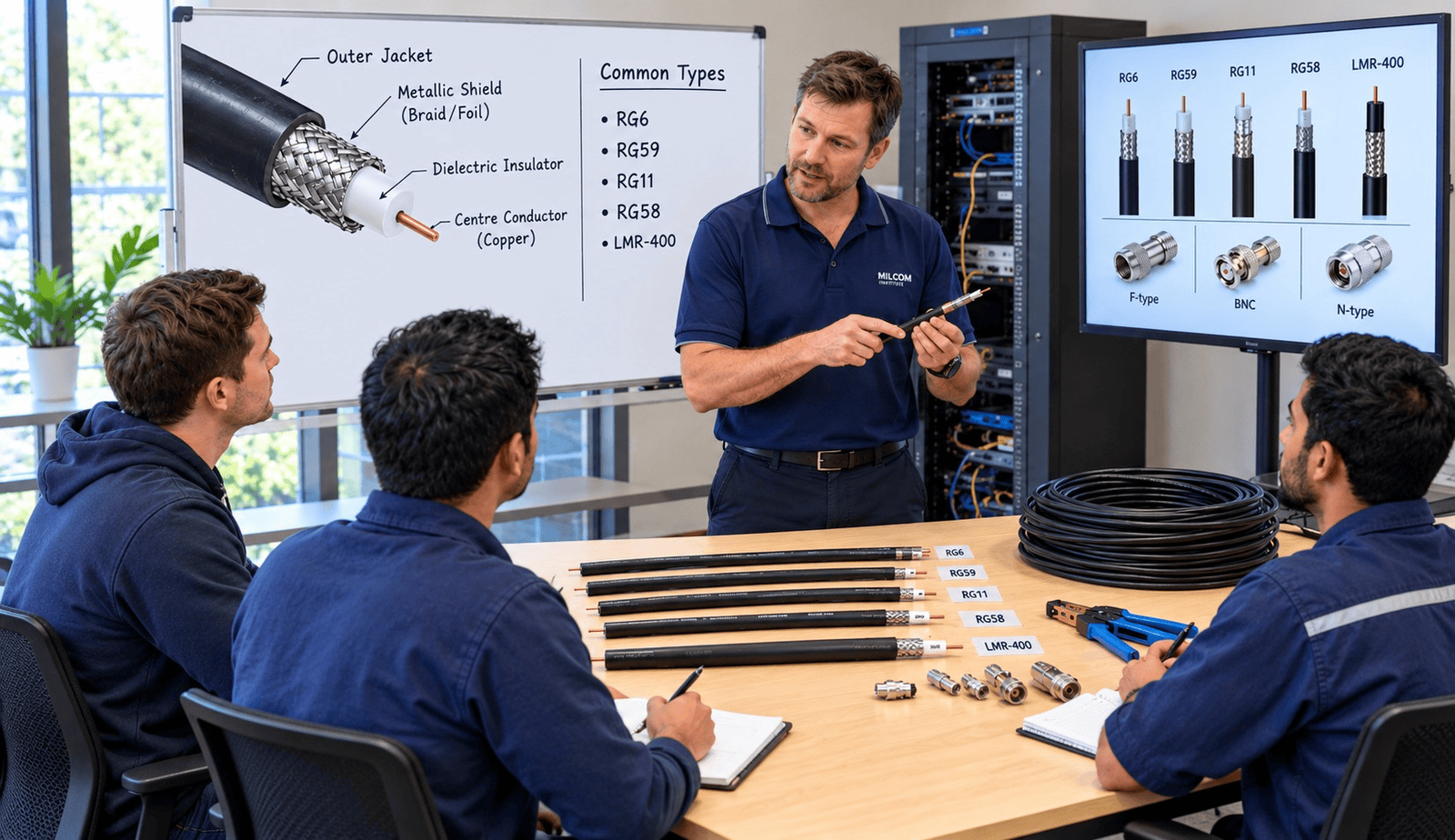
A coaxial cable is a shielded transmission cable with four layers sharing one axis: a copper or copper-clad steel centre conductor, a dielectric insulator, a metallic shield (braid, foil or both), and an outer jacket. This design carries radio-frequency signals for TV, internet, CCTV and antenna systems while blocking outside interference.
What are the main types of coaxial cable?
The most common coaxial cable types in Australia are RG6 (pay TV, NBN HFC and antenna systems), RG59 (short-run CCTV and legacy video), RG11 (long runs and trunk lines), and LMR/hardline variants for communications infrastructure. “RG” stands for Radio Guide, a legacy military designation that stuck.
| Type | Impedance | Typical use | Max practical run |
|---|---|---|---|
| RG6 | 75 Ω | TV antenna, Foxtel, NBN HFC lead-ins | ~50 m |
| RG59 | 75 Ω | Analogue CCTV, short video runs | ~230 m (video) |
| RG11 | 75 Ω | Trunk lines, long antenna runs | ~100 m+ |
| RG58 | 50 Ω | Two-way radio, thin Ethernet (legacy) | ~50 m |
| LMR-400 | 50 Ω | Wireless/antenna feeder, 4G/5G | ~100 m+ |
What is the difference between RG6 and RG59?
RG6 has a thicker centre conductor (18 AWG vs 20 AWG), better shielding and lower loss at high frequencies, making it the standard for digital TV, satellite and cable broadband. RG59 suits short, low-frequency runs such as analogue CCTV. For any new install carrying digital signals, RG6 is the default choice.
What is 75 ohm vs 50 ohm coax used for?
75 ohm cable (RG6, RG59, RG11) is optimised for video and broadcast signals — TV, satellite, cable internet. 50 ohm cable (RG58, LMR series) is optimised for radio transmitters, two-way radio and wireless antennas where power handling matters more than lowest signal loss.
Which coaxial cable does the NBN use?
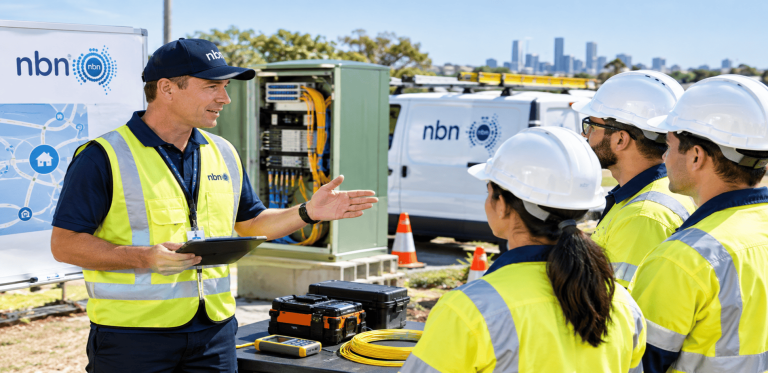
The NBN Hybrid Fibre Coaxial (HFC) network uses RG6 (or better) coaxial cable for the lead-in between the street tap and the premises, connected with F-type compression connectors. Working on this network requires ACMA cabler registration — and a coaxial endorsement.
Do I need a licence to install coaxial cable in Australia?
Yes. Under ACMA cabling provider rules, installing fixed coaxial cabling that connects (or could connect) to the telecommunications network requires a registered cabler licence with a coaxial cabling endorsement. Milcom Institute delivers the ICTCBL303 coaxial endorsement in as little as half a day, from $225.
Frequently asked questions
Can I mix RG6 and RG59 in one system?
It works electrically but is poor practice: the impedance matches, yet mismatched loss characteristics degrade signal quality, especially on digital services. Use one grade per run.
How do I identify a coaxial cable type?
Check the jacket print — manufacturers stamp the type (e.g. “RG6/U 75 Ω”) along the cable every 30–60 cm.
What connectors do coaxial cables use?
F-type (TV/broadband), BNC (CCTV/professional video) and N-type (wireless infrastructure) are the most common. See our guide to coaxial connectors.
Want to work with coax professionally? Start with ACMA Open Registration, add the Coaxial Endorsement, or take the HFC course for NBN work. Call 1300 369 320.