
Updated July 2026 by Milcom Institute (RTO 6859).
What is a coaxial cable connector?
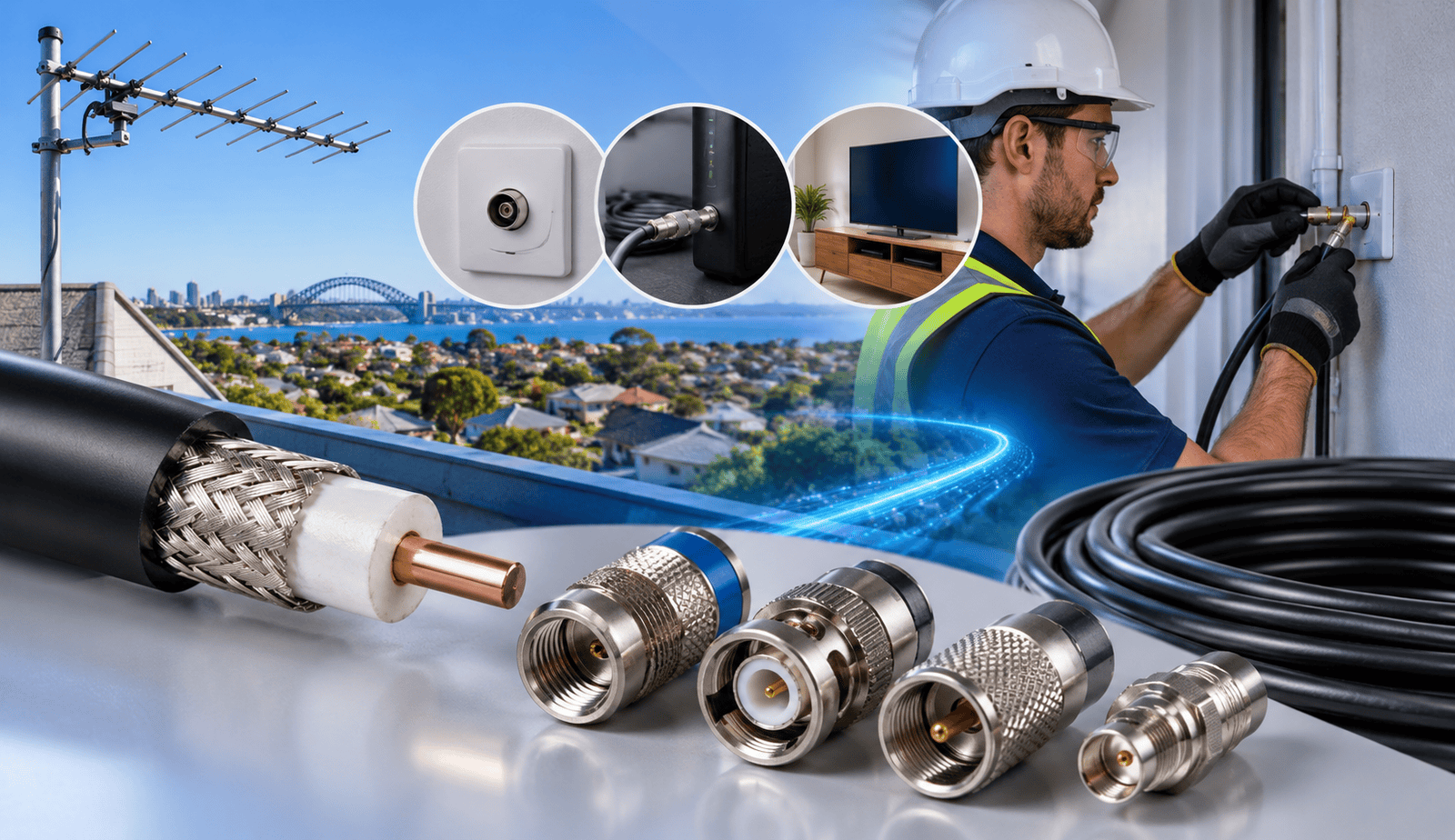
A coaxial connector is a fitting that terminates the end of a coaxial cable so it can join equipment or another cable while preserving the cable’s shielding and impedance. A good connector maintains the same 75 or 50 ohm impedance as the cable, keeping signal loss and reflections to a minimum.
How does a coaxial connector work?
The connector continues the cable’s two-conductor design: the centre pin carries the signal, while the connector body bonds to the cable’s shield to complete the return path and block interference. Compression, crimp or twist-on mechanisms clamp the connector onto the cable; threaded or bayonet couplings then lock it to the mating port.
What are the main types of coaxial connectors?
| Connector | Coupling | Impedance | Typical use |
|---|---|---|---|
| F-type | Threaded | 75 Ω | TV antenna, Foxtel, NBN HFC |
| BNC | Bayonet | 50/75 Ω | CCTV, professional video |
| N-type | Threaded | 50 Ω | Wireless antennas, 4G/5G infrastructure |
| SMA | Threaded | 50 Ω | Radios, antennas, test gear |
| RCA | Push-on | — | Legacy AV equipment |
Compression vs crimp vs twist-on: which is best?
Compression connectors give the most reliable, weather-resistant termination and are the industry standard for F-type on RG6 — required practice on pay TV and NBN HFC work. Crimp connectors are acceptable when done with the correct tool; twist-on connectors are a temporary fix at best and unsuitable for professional installs.
Why do connectors matter for signal quality?
Most faults in coaxial systems occur at terminations, not in the cable run. A poorly fitted connector causes impedance mismatch, signal reflection, ingress (interference leaking in) and egress (signal leaking out — a compliance issue on cable networks). Proper preparation, the right connector for the cable grade, and correct tooling prevent all of these.
Frequently asked questions
Are all F-type connectors the same?
No — they’re sized for specific cable grades (RG6, RG6 Quad, RG11). Using the wrong size causes intermittent faults.
Can I terminate coax myself at home?
You can replace a fly lead, but fixed cabling that connects to the network must be done by an ACMA-registered cabler with a coaxial endorsement.
Which connector does CCTV use?
Analogue and HD-over-coax CCTV typically uses BNC connectors on RG59 or RG6. Learn hands-on termination in our CCTV Installation course.
Learn professional coax termination: the ICTCBL303 Coaxial Cabling endorsement takes half a day and costs from $225. See also our guide to coaxial cable types.