
Australia’s telecommunications industry continues to evolve, creating opportunities for skilled professionals who understand different types of cabling systems. Among these, coaxial cabling remains an important technology for a range of communication, broadband, video and data applications.
For technicians looking to expand their cabling skills, completing a coaxial cable course in Australia can provide valuable practical knowledge in cable installation, termination and testing.
MILCOM Institute offers ICTCBL303 – Install and terminate coaxial cable, a specialised training course designed to develop the practical skills required to work with coaxial cabling systems.
But what exactly is coaxial cable, where is it used, and how can professional training support your cabling career?
Let’s explore everything you need to know.
What Is a Coaxial Cable?
A coaxial cable, commonly known as coax cable, is a type of electrical cable designed to carry communication signals.
Unlike ordinary electrical cables, coaxial cables have a specific layered construction that helps protect the signal from external interference.
A typical coaxial cable contains four main components:
- Inner conductor – carries the electrical signal.
- Dielectric insulator – separates the conductor from the shielding.
- Conductive shield – helps reduce electromagnetic interference.
- Outer jacket – protects the cable from physical and environmental damage.
This construction makes coaxial cable suitable for transmitting various types of signals, including data, video, voice and broadband communications.
Why Is Coaxial Cabling Still Important in Australia?
Although fibre optic technology has become increasingly important in modern telecommunications, coaxial cabling continues to have practical applications.
Coaxial cable can be found in areas such as:
- Broadband communication systems
- HFC networks
- Television services
- Satellite installations
- Digital broadcasting
- Video transmission
- Telephony
- Data communication
- LAN and WAN environments
- Multimedia systems
This means technicians who understand coaxial installation and termination can add another valuable skill to their existing telecommunications capabilities.
What Are the Different Types of Coaxial Cable?
Not every coaxial cable is designed for the same application. Different cable types have different construction, performance characteristics and intended uses.
RG-6 Coaxial Cable
RG-6 is one of the most commonly encountered coaxial cable types. It is widely used in television, satellite and broadband-related applications.
RG-11 Coaxial Cable
RG-11 is generally thicker than RG-6 and can be suitable for applications involving longer cable runs where signal loss needs to be considered.
RG-59 Coaxial Cable
RG-59 has traditionally been used for video and CCTV applications. The appropriate cable should always be selected according to the requirements of the particular installation.
Other Coaxial Cable Types
Other examples include RG-213 and RG-214, which can be used in specialised communication applications.
A trained cabling technician needs to understand how to identify cable types and select the appropriate cable for the installation.
What Does a Coaxial Cable Course Teach You?
A professional coaxial cabling course focuses on more than simply connecting cables.
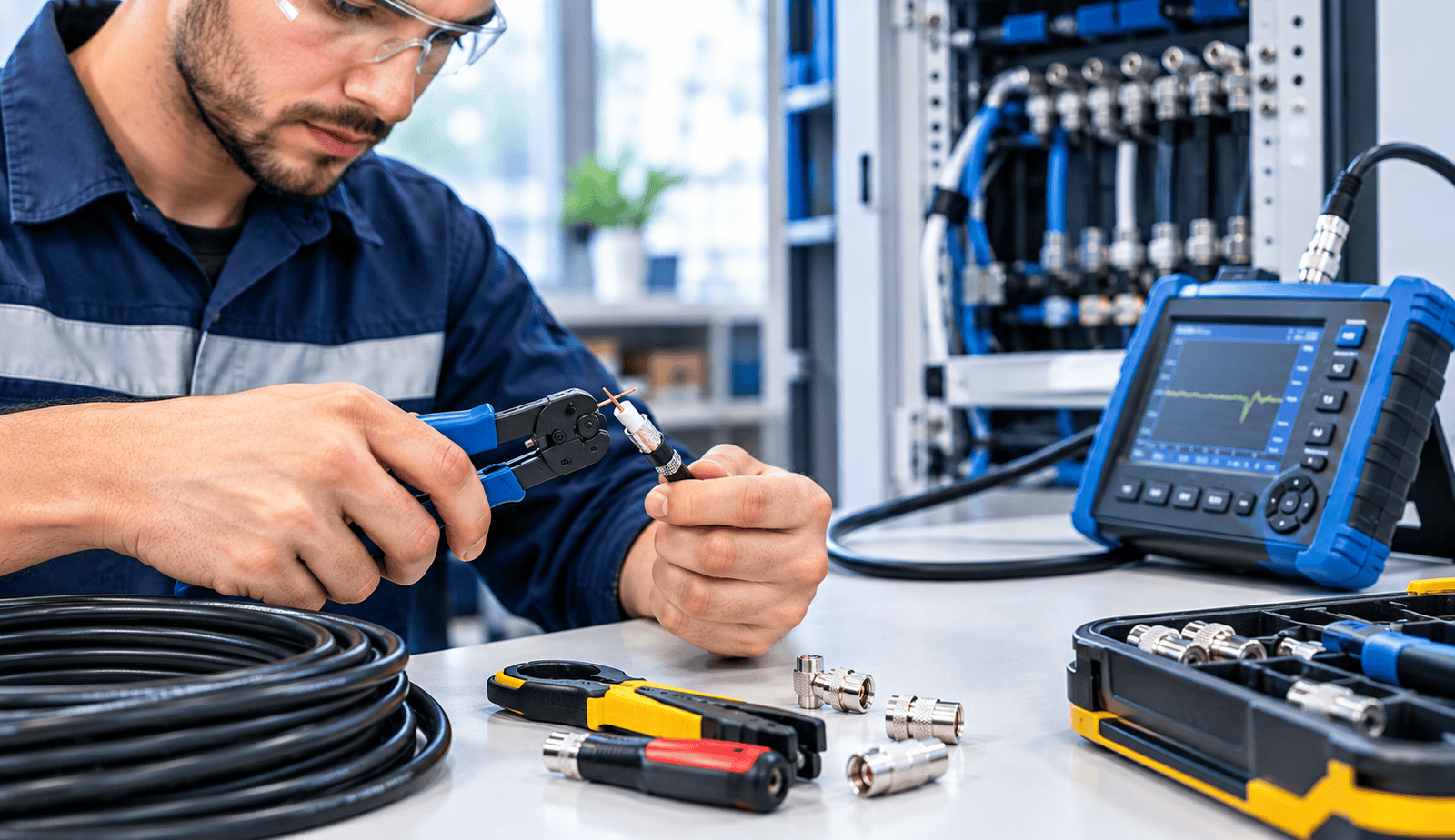
It can teach participants how to correctly identify, prepare, terminate and test coaxial cabling systems.
MILCOM’s ICTCBL303 – Install and terminate coaxial cable covers practical skills associated with installing, terminating and testing coaxial cable across a range of communication applications.
The training includes areas such as:
- Identifying coaxial cable systems
- Understanding coaxial cable construction
- Selecting appropriate tools and equipment
- Preparing coaxial cables for termination
- Installing coaxial connectors
- Terminating coaxial cables
- Testing completed terminations
- Applying safe work practices
- Understanding industry requirements
These skills can help technicians improve their confidence when working with coaxial cabling in practical environments.
What Is ICTCBL303?
ICTCBL303 – Install and terminate coaxial cable is a nationally recognised unit of competency focused on the installation and termination of coaxial cable.
The unit covers the skills and knowledge required to install and terminate coaxial cable across applications involving areas such as digital and analogue systems, telephony, data, video, digital broadcasting, computer networks and multimedia systems.
For technicians looking to develop specialised coaxial cabling competency, ICTCBL303 can be an important addition to their professional training pathway.
What Is an ACMA Coaxial Cabling Endorsement?
The Australian Communications and Media Authority (ACMA) regulates cabling registration in Australia.
Cabling registration allows registered cablers to perform telecommunications cabling work within the scope of their registration.
ACMA also recognises specialised cabling competencies, including competencies associated with coaxial cabling.
This is where specialised training can become particularly valuable for technicians who want to expand their cabling capabilities.
However, it is important to understand that completing a coaxial cabling course does not automatically provide an ACMA cabling registration.
Depending on the registration pathway, additional requirements can apply, including relevant cabling experience and the cabling regulations test.
How Does Coaxial Cabling Connect With NBN HFC Networks?
One of the reasons coaxial cabling remains relevant to Australian telecommunications is Hybrid Fibre Coaxial (HFC) technology.
HFC combines fibre optic infrastructure with coaxial cable in parts of the network.
For technicians working in telecommunications, understanding coaxial cable installation, termination and testing can therefore be a useful technical skill.
However, the type of work a cabler can legally perform depends on their registration, competencies, applicable requirements and the scope of the particular project.
Therefore, anyone planning to work on telecommunications infrastructure should make sure they understand the relevant registration and industry requirements before undertaking cabling work.
Why Choose Professional Coaxial Cabling Training?
Learning coaxial cabling through practical training can help technicians develop skills that are difficult to gain from theory alone.
Incorrect cable preparation or poor connector termination can affect signal performance and the reliability of a communication system.
Professional training can help you understand the correct process:
Identify → Prepare → Terminate → Test → Verify
This practical approach helps build a stronger understanding of coaxial cabling and the importance of quality workmanship.
Who Should Consider a Coaxial Cabling Course?
A coaxial cable course may be suitable for people already working in, or planning to enter, telecommunications and related technical industries.
It can be particularly relevant to:
- Telecommunications technicians
- Cabling technicians
- Network technicians
- Communications technicians
- Antenna technicians
- Pay TV installers
- Technical workers
- Existing cablers wanting to develop additional skills
If you already have experience in telecommunications, adding coaxial cabling competency can help broaden your technical skill set.
What Career Opportunities Can Coaxial Cabling Skills Support?
Completing specialised cabling training can support career development in several technical areas.
Potential roles can include:
Coaxial Cable Installer
A coaxial cable installer works with coaxial cabling systems, including cable preparation, installation and termination.
Telecommunications Technician
Telecommunications technicians may work across different communication technologies and infrastructure, depending on their qualifications and registration.
Antenna Technician
Antenna technicians can work with television and communication antenna systems where coaxial cabling is part of the installation.
Pay TV Installer
Coaxial cabling knowledge can also be relevant to technicians involved in television and subscription-based entertainment installations.
Your career opportunities will depend on your qualifications, experience, registration, competencies and the requirements of individual employers or projects.
What Are the Entry Requirements for MILCOM’s Coaxial Cabling Course?
MILCOM currently lists no formal entry requirements for its ICTCBL303 Coaxial Cabling course.
This can make the course an accessible option for people looking to develop specialised coaxial cabling skills.
However, if your long-term goal is ACMA cabler registration, you should consider the broader registration requirements rather than viewing the course as a standalone licence.
How Long Does a Coaxial Cabling Course Take?
MILCOM’s ICTCBL303 Coaxial Cabling course is designed as a short, focused training program.
The course can be completed in up to half a day, depending on the delivery option and individual circumstances.
MILCOM provides training options including face-to-face and blended learning, helping technicians choose a format that suits their professional and learning requirements.
How to Start a Cabling Career in Australia
If you’re considering a career in telecommunications cabling, a structured approach can help.
- Choose Your Career Path
Start by identifying the type of cabling work you want to undertake.
- Complete Relevant Training
Choose nationally recognised training that matches your intended area of work.
- Develop Practical Experience
Practical experience is an important part of developing professional cabling competency.
- Understand ACMA Requirements
If you intend to become a registered cabler, make sure you understand the applicable ACMA requirements for your chosen registration category.
- Complete Additional Specialised Training
Specialised units such as coaxial cabling, structured cabling and optical fibre can help broaden your technical capabilities.
- Keep Your Skills Current
Telecommunications technology continues to change. Ongoing professional development can help technicians remain competitive and capable in the industry.
Why Train With MILCOM Institute?
MILCOM Institute is a Registered Training Organisation (RTO) providing telecommunications and technical training in Australia.
Its ICTCBL303 Coaxial Cabling course focuses on practical skills for installing, terminating and testing coaxial cable.
For technicians wanting to add specialised coaxial cabling skills to their professional toolkit, the course provides a focused pathway to develop relevant technical knowledge and practical competency.
MILCOM also provides other telecommunications training options, allowing learners to build broader skills across areas such as structured cabling and optical fibre.
Frequently Asked Questions About Coaxial Cable Courses
What is a coaxial cable course?
A coaxial cable course provides training in identifying, installing, terminating and testing coaxial cabling systems. It is designed to help participants develop practical skills for working with coaxial cable.
What is ICTCBL303?
ICTCBL303 is the unit of competency Install and terminate coaxial cable. It covers the skills and knowledge required to install and terminate coaxial cable for a range of communication applications.
Does a coaxial cable course give you an ACMA cabling licence?
No. Completing a coaxial cabling course does not automatically provide ACMA cabler registration. Additional requirements can apply depending on the registration category and individual circumstances.
Is coaxial cabling used in NBN networks?
Yes. Coaxial cable forms part of Australia’s HFC telecommunications infrastructure. However, the specific work a cabler can undertake depends on their registration, competency and applicable industry requirements.
Who should complete a coaxial cabling course?
The training can be useful for telecommunications technicians, cablers, network technicians, antenna technicians, Pay TV installers and other technical professionals who want to develop coaxial cabling skills.
How long is MILCOM’s coaxial cabling course?
MILCOM currently lists ICTCBL303 as a course that can be completed in up to half a day, depending on the delivery option and learner circumstances.
What do you receive after completing the course?
Successful participants receive a Statement of Attainment for the relevant unit of competency, subject to meeting the assessment requirements.
Build Your Coaxial Cabling Skills With MILCOM
Coaxial cable remains an important part of Australia’s communications landscape, particularly across applications involving broadband, video, broadcasting and HFC infrastructure.
For technicians looking to expand their capabilities, completing a coaxial cable course in Australia can provide practical knowledge in cable installation, termination and testing.
MILCOM Institute’s ICTCBL303 – Install and terminate coaxial cable provides focused training for professionals who want to strengthen their coaxial cabling skills and add specialised competency to their telecommunications career.
Ready to expand your cabling skills? Explore MILCOM’s Coaxial Cabling course and take the next step in your telecommunications career.