
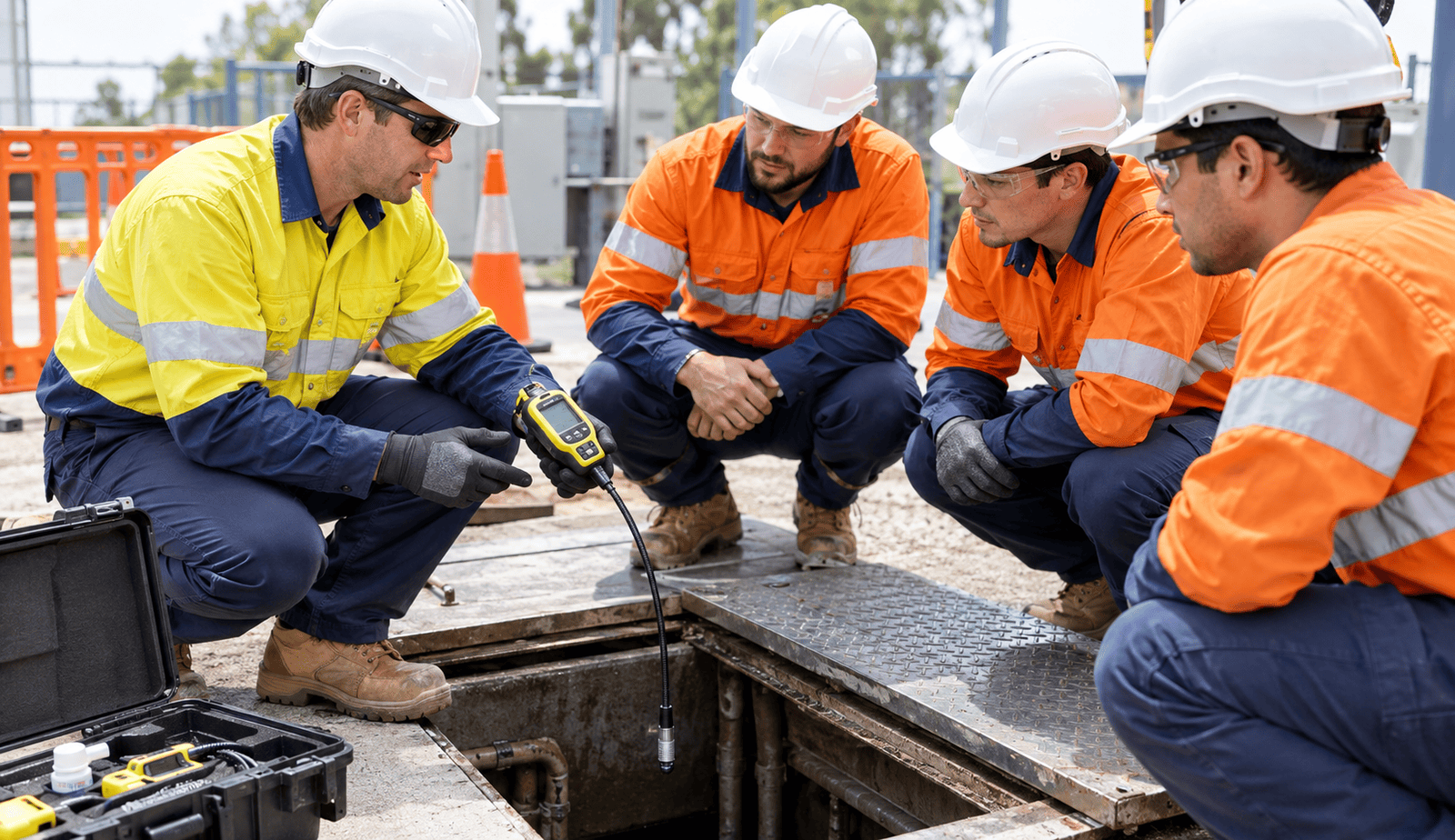
Imagine a telecommunication crew preparing to work beside a service pit in an underground network. The tools are set to go, but an atmospheric assessment still remains. Gas test atmosphere training is aimed to develop skills in using electronic detection apparatus, making conclusions out of the readings and reporting them to make decisions about the work to be done. According to Australia, competencies in gas test atmospheres are contained in MSMWHS217 – Gas test atmosphere Training.
For field technicians, the environment is just another part of the work.
Key Takeaways
- Atmospheric dangers might need special equipment to detect.
- Testing includes preparation, reading, communication and documentation.
- Practical testing enables us to prove proficiency in gas testing.
- Gas testing training doesn’t cover confined space entry requirements.
What Is Gas Test Atmosphere Training?
Gas test atmosphere training is intended to teach workers to perform assessment of workplace atmosphere using electronic test apparatus. Participants acquire skills in making conclusions about their readings and taking appropriate actions according to the workplace procedures.
The skill can be used not only in telecommunications underground, but in other situations such as work in enclosed environments or in certain industrial operations. Its aim is to give the reliable data for the work to be performed. Official unit requirements.
Why Does It Matter on the Job?
A well-known place of work might still involve atmospheric dangers. Enclosed environments might contain hazardous substances or inadequate oxygen level. Visual inspection alone doesn’t prove suitability for work. Australian guidelines.
For technicians, electricians and labourers who are assigned the atmospheric testing duties, training links the operation of the equipment and responsible reporting. Advantages of it include better communication, understanding of readings and testing procedures.
The practical value lies in knowing what data to collect and how it relates to the work.
Returning to the scenario at the beginning of the text, the crew needs more than a digital display. Relevant personnel will need a clear report connecting the reading with the work to be done. Training will help learners to understand their responsibility before encountering it at work.
How Does Training Enable Gas Testing Skills?
The above steps describe learning areas, but not the complete procedure of testing.
- Understanding the Work
Learners consider the work proposed, atmospheric dangers involved in it and the testing procedure established by workplace procedures.
- Preparation of the Equipment
Participants gain skills in selecting and preparing of the appropriate equipment, including inspection and calibration procedures.
- Testing and Interpreting
Practical learning will connect the usage of the tester with understanding the readings. Recognizing a reading is not the same as interpreting it properly for the work.
- Reporting and Monitoring
Learners will practice reporting the findings, communicating necessary actions and monitoring the conditions if the work requires testing continuously.
- Maintenance and Documentation
Inspection, cleaning, detection of faults and accurate documentation complete the learning process. All this ensures reliable testing and tracing of the results.
Where Can These Skills Be Used?
Let’s consider three examples of application:
Telecommunications maintenance: A worker responsible for atmospheric testing around a service pit will have to report his findings before proceeding.
Underground installation: A cable crew will coordinate their work with the necessary atmospheric testing and control.
Industrial maintenance: People assisting in the work near the enclosed vessel will need testing data concerning the work to be done.
In all these cases testing will complement the safety arrangements. It will not independently prove that all the hazards are controlled.
Common Mistakes and Challenges
Believing familiarity equals safety: previous experience in a location doesn’t prove its current atmospheric situation.
Attention to the detector alone: Although equipment operation is important, interpretation, reporting and documentation deserve as much attention.
Neglecting the condition of the equipment: faults or inappropriate equipment can spoil the testing. Follow the relevant inspection and maintenance procedures.
Mixing up training and authorization: completion of the unit doesn’t automatically authorize every task or replace the site requirements.
Gas Testing or Confined Space Entry?
These competencies are related, but serve different purposes.
- Aspect
- Gas testing
- Confined space entry
- Purpose
- Atmospheric assessment
- Entry and work arrangements
- Important point
- Readings and reporting
- Other hazards and controls
- Connection
- Assessment support
- Might require atmospheric testing
Choosing Training to Suit Your Work
Discuss with your supervisor what competencies your job requires. Then compare courses by their content, practical assessment, delivery and outcomes.
For blended learning courses, find out the load of theoretical material and required practical attendance. Choose the training which suits your responsibilities, not ticket collection.
Ask about interpretation of readings and equipment problems during the training. If you have experience, discuss it with the provider without assuming that it is equivalent to assessment. Clear expectations will enable you to prepare and schedule your studying time.
Discuss these things before making the payment for the course.
Frequently Asked Questions
What is gas test atmosphere?
Gas test atmosphere is an assessment of the workplace atmosphere using electronic testers and interpreting of the findings according to the relevant procedures.
What is the recognized unit code?
MSMWHS217 – Gas test atmospheres is the nationally recognized unit code connected to this trail.
Whom should consider the training?
People assigned to atmospheric testing duties should consider this training, including telecommunication, maintenance and underground network personnel.
What can the successful learners receive as a result?
The completion of nationally recognized training and assessment in MSMWHS217 allows obtaining a Statement of Attainment.
Does the training cover confined space entry?
Gas testing training covers the atmospheric assessment. For confined space entry, other competencies and workplace arrangements are required.
Is gas testing possible only in underground?
Gas testing can be used in other environments and other tasks, requiring the assessment of the atmosphere, including some industrial operations.
Why is practical assessment important?
Practical assessment allows demonstrating equipment operation, interpretation and reporting skills, connecting theoretical knowledge with realistic tasks.
Can the related training be combined?
Gas testing can be combined with the relevant infrastructure training. Make sure that units included in the course correspond to your responsibilities.
Conclusion: Train in Gas Testing at Milcom
Milcom provides Gas Test Atmospheres training containing MSMWHS217, which allows getting a nationally recognized Statement of Attainment upon successful completion. The information provided on its course page says that there are no entry requirements and the duration is up to half a day.
Blended learning consists of online theoretical studies and practical attendance. Make sure about current fees, preparation and availability before signing up.
For underground skills of the broader type, check Milcom’s combined infrastructure training.
Next step: visit Milcom’s Gas Test Atmospheres course page or call 1300 369 320 to discuss the training suitable for your work.