

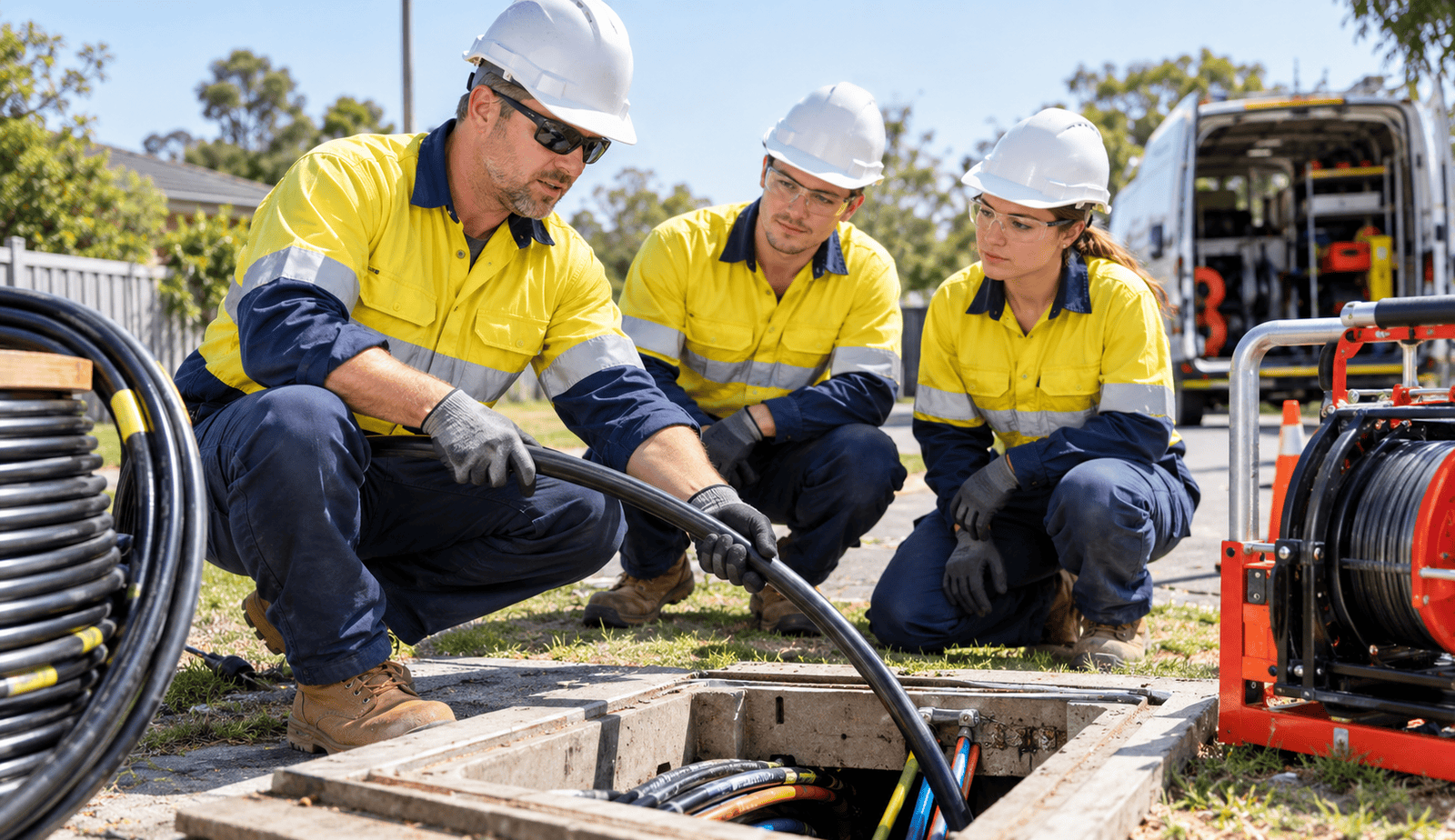
Installing underground telecommunications infrastructure requires more than simply placing cables in the ground. Technicians need to understand pit and pipe installation, conduit preparation, cable hauling, customer lead-ins, cable protection and workplace safety.
The Combined Pit & Pipe and Cable Hauling Pack is designed for learners and telecommunications workers who want to develop practical skills across underground telecommunications infrastructure.
The training covers important areas associated with installing and working with telecommunications conduits and pits, as well as hauling different cable types, including multi-pair, coaxial and optical fibre cables.
What Is a Combined Pit & Pipe and Cable Hauling Course?
A Combined Pit & Pipe and Cable Hauling course provides practical training in installing telecommunications pits and conduits and safely hauling underground telecommunications cables.
The training can help participants understand how to:
- Install telecommunications pits and conduits
- Prepare underground cable pathways
- Install and recover telecommunications cables
- Manage customer lead-ins
- Haul underground telecommunications cables
- Work with multi-pair cables
- Work with coaxial cables
- Work with optical fibre cables
- Remediate damaged or undersized pits
- Follow workplace safety and industry procedures
Developing these skills can be valuable for technicians involved in telecommunications infrastructure and underground cabling projects.
What Are Telecommunications Pits and Pipes?
Telecommunications pits and pipes are underground infrastructure used to provide pathways and access points for telecommunications cables.
Conduits or pipes provide a protected pathway through which telecommunications cables can be installed, while pits provide access points for cable installation, maintenance, jointing and network management.
This infrastructure can be used in developments such as:
- Residential developments
- Adjoining dwellings
- Horizontal multi-dwelling developments
- Multiple stand-alone dwellings
- New residential lots
- Public or private developments
- Super lots
Correct installation of pits, pipes and conduits is important because underground infrastructure needs to provide suitable pathways and access for telecommunications cabling.
Why Are Pit and Pipe Skills Important for Telecommunications Technicians?
Underground telecommunications networks depend on correctly installed pathways and infrastructure.
Poor installation practices can create difficulties during cable hauling, maintenance, fault finding and future network upgrades.
Technicians therefore need to understand practical considerations such as:
- Cable pulling techniques
- Cable protection
- Conduit preparation
- Cable length management
- Lubrication
- Rollers and cable handling equipment
- Pit and conduit condition
- Sealing requirements
- Workplace safety
Practical training helps technicians understand how these procedures are applied in real-world work environments.
What Is Cable Hauling?
Cable hauling is the process of safely pulling or installing telecommunications cable through underground conduits or other designated pathways.
Cable hauling needs to be performed carefully because excessive pulling force, poor cable handling or inadequate preparation can damage the cable sheath or affect the cable’s performance.
Depending on the project, technicians may work with different types of telecommunications cables, including:
- Multi-pair copper cable
- Coaxial cable
- Optical fibre cable
The correct cable handling method depends on the cable type, installation environment, equipment and project requirements.
What Does MILCOM’s Cable Hauling Training Cover?
MILCOM’s Combined Pit & Pipe and Cable Hauling Pack focuses on practical skills associated with underground telecommunications infrastructure.
Participants can develop knowledge and practical capability in areas such as:
-
Installing and Recovering Telecommunications Cables
Learn procedures associated with installing and recovering telecommunications cables while reducing the risk of unnecessary cable damage.
-
Customer Lead-In Installation
Understand practical considerations involved in installing customer lead-ins as part of telecommunications infrastructure.
-
Underground Cable Hauling
Develop practical knowledge of hauling telecommunications cable through underground conduits and infrastructure.
-
Multi-Pair Cable Installation
Understand cable handling and installation practices relevant to multi-pair telecommunications cable.
-
Coaxial Cable Installation
Develop practical awareness of hauling and handling coaxial cables within underground telecommunications infrastructure.
-
Optical Fibre Cable Handling
Learn important cable-handling considerations when working with optical fibre infrastructure.
Because fibre optic cable can be sensitive to excessive pulling force and improper handling, technicians need to follow appropriate installation and handling procedures.
Key Learning Outcomes of the Combined Pit & Pipe and Cable Hauling Pack
The course is designed to help participants develop practical skills and knowledge for underground telecommunications work.
Key learning outcomes include:
Maintain Appropriate Cable Length for Jointing
Technicians need to allow sufficient cable length for future jointing and related work.
Proper cable management can help support efficient installation and maintenance activities.
Use Appropriate Lubrication During Cable Hauling
Lubrication may be used during cable hauling to help reduce friction and minimise the risk of unnecessary cable damage.
Technicians need to apply appropriate procedures based on the cable, conduit and installation requirements.
Use Cable Rollers and Pumps Correctly
Cable rollers and suitable cable-handling equipment can help support controlled cable movement and reduce the risk of sheath damage during installation.
Follow Workplace Safety Procedures
Underground telecommunications work needs to be completed in accordance with applicable workplace safety requirements, procedures and project instructions.
Safety should remain a priority throughout pit, pipe and cable hauling activities.
Keep Pipes and Conduits Clear
Technicians need to ensure that conduit pathways are appropriately prepared and free from obstructions that could interfere with cable installation.
Seal Pipe Entries and Enclosures
Appropriate sealing practices can help protect infrastructure from the entry of unwanted external material and maintain the condition of the installation.
What Is Pit and Pipe Remediation?
Pit and pipe remediation involves repairing, replacing or addressing underground telecommunications infrastructure that is damaged, unsuitable or undersized.
Existing infrastructure may require remediation when a pit or conduit no longer meets the requirements of the planned telecommunications installation.
Understanding remediation procedures can therefore be an important skill for technicians working on existing underground telecommunications infrastructure.
Who Should Consider Pit & Pipe and Cable Hauling Training?
The Combined Pit & Pipe and Cable Hauling Pack can be relevant to:
- Telecommunications technicians
- Cabling technicians
- Telecommunications contractors
- Cable installers
- Underground infrastructure workers
- Communications technicians
- Technicians looking to expand their cabling skills
- People starting a career in telecommunications
The training may be particularly useful for workers who want to develop practical knowledge across underground telecommunications infrastructure and cable installation.
Why Choose Practical Telecommunications Training at MILCOM?
MILCOM Institute provides practical telecommunications training designed to help learners develop industry-relevant technical skills.
Hands-on training can help participants understand how telecommunications infrastructure is installed, handled and maintained in practical work environments.
MILCOM’s training approach focuses on combining technical knowledge with practical activities so participants can develop greater confidence with tools, equipment, cables and installation procedures.
For technicians who already have experience in telecommunications, additional training can also help expand their existing skill set.
Build Your Underground Telecommunications Skills
Underground telecommunications infrastructure requires technicians who understand how to prepare pathways, manage cables and work safely.
Developing skills in pit and pipe installation, cable hauling, cable handling and remediation can complement other telecommunications capabilities such as structured cabling, coaxial cabling, copper cabling and optical fibre.
A broader technical skill set can help telecommunications professionals adapt to different project and infrastructure environments.
Frequently Asked Questions About Pit & Pipe and Cable Hauling
What is a pit and pipe course?
A pit and pipe course teaches practical skills related to telecommunications pits, conduits and underground cable pathways, including installation, preparation, remediation and safe work practices.
What is cable hauling in telecommunications?
Cable hauling is the process of safely pulling telecommunications cable through underground conduits or other designated pathways using appropriate techniques and equipment.
What types of cable can be installed through underground conduits?
Depending on the telecommunications project, underground conduits may be used for cables such as multi-pair copper, coaxial and optical fibre cables.
Why is cable lubrication important during cable hauling?
Appropriate lubrication can help reduce friction during cable installation and may help minimise unnecessary stress or damage to the cable, when used according to the relevant installation requirements.
What are telecommunications pits used for?
Telecommunications pits provide underground access points for cables and infrastructure, supporting activities such as cable installation, maintenance, jointing and network management.
What is pit and pipe remediation?
Pit and pipe remediation involves addressing damaged, unsuitable or undersized telecommunications pits or conduits so that the infrastructure can meet the requirements of the intended installation.
Who should complete pit and pipe and cable hauling training?
The training can be useful for telecommunications technicians, cable installers, contractors and other workers who want to develop practical skills in underground telecommunications infrastructure.
Does MILCOM offer combined pit and pipe and cable hauling training?
Yes. MILCOM provides a Combined Pit & Pipe and Cable Hauling Pack covering practical areas associated with telecommunications pits, conduits, underground cable hauling and cable handling.
Key Takeaways
- Pit and pipe infrastructure provides pathways and access points for underground telecommunications cables.
- Cable hauling involves safely installing telecommunications cable through underground pathways.
- Training can cover multi-pair, coaxial and optical fibre cable handling.
- Practical skills include cable management, lubrication, rollers, cable hauling and conduit preparation.
- Pit and pipe remediation addresses damaged or unsuitable underground telecommunications infrastructure.
- Safety and correct cable-handling procedures are essential during underground telecommunications work.
- MILCOM’s Combined Pit & Pipe and Cable Hauling Pack provides practical training for telecommunications professionals and aspiring technicians.
Ready to Develop Your Telecommunications Cabling Skills?
Want to strengthen your knowledge of underground telecommunications infrastructure, pit and pipe installation and cable hauling?
Explore MILCOM’s Combined Pit & Pipe and Cable Hauling Pack to develop practical skills relevant to telecommunications cabling work.
Contact MILCOM Institute to learn more about course content, training options and enrolment requirements.